
The Lord of the Rings as a Hollywood Blockbuster

The Lord of the Rings as a Hollywood Blockbuster

Blockbusters have been around since the 1950s – but Jaws changed the game in the 70s. Since Jaws was released twenty-odd years before I was born, I have become quite affiliated with blockbusters. It seems every year since I was born, there has been a larger than life Hollywood blockbuster film dominating the cinema from months April – August (a trend set by Jaws). Iconic blockbusters ranging from Lion King, to Pirates of the Caribbean, to James Bond, to Marvel’s Cinematic Universe demolition in current day. But one franchise that has always made me question “Is it like the others?” – none other than The Lord of the Rings. I will review attributes – or lack of –  of a Hollywood blockbuster, and apply them to The Lord of the Rings: Return of the King (LOTR: ROTK) to at last, get an answer I have desired. Is LOTR: ROTK a stock-standard Hollywood blockbuster, or does it break the conformity?

288ccc78c2de9f1f643cd77784d8f7ea
Credit to: Dan Mumford. Alternate Movie Poster.

Blockbusters are all about the dollars. It can be argued there has been a transition in debating the quality of a blockbuster film to how well it ranked in the top grossing films. The importance has shifted. LOTR: ROTK was no different when it came to finance — at least, the quantity of funds. LOTR: ROTK had a budget of 94 million dollars, which at the time was astronomical. But the film made the 94 million dollars back, and some more. Box Office Mojo reports the film made an incredible $1 119 929 521. At time of writing, it is the 16th highest grossing film ever, and peaked at second when released.

All this talk of money leads us to question where the money came from. 94 million dollars is huge sum — and it easy to understand why it was needed considering they had to pay a production team of 2400 people and 26 000 extras. Unusual for a blockbuster to use a team of this number. The film is advertised as an ‘American Fantasy Blockbuster’. But, what exactly makes it American? The director? No, New Zealand. Shooting location? No, New Zealand. The cast? Partially. There are Americans, but also English, Danish, Scottish, and Australian to name a variety. FUNDING? No, New Zealand subsidiaries. This is a unique and intriguing perspective for LOTR: ROTK. This ties directly in with Julian Stringer of Movie Blockbusters analysis of Hollywood’s ongoing close relation to global cultures and importance of money. Advertised as an American film could be an insight into the financial or corporate driven necessity of a blockbuster to dominate the U.S. market.

A characteristic of a blockbuster is they are not restricted to a sole source of income. Blockbusters are proactive upon release by strategising a way to become cross-platform successes. Basically, this means how can the film be even more successful beyond the movie, and as a brand. There is no denying LOTR: ROTK (and The Hobbit franchise) fit this mould to a ‘T’. However, LOTR cross-platform success is a little different. Forbes recognise the franchise’s staple products like toys, board games, posters, soundtracks — but credit LOTR for its individuality in regards to co-branding with AIR New Zealand, New Zealand postal stamps and economic tourism impact for New Zealand. In a research survey, 1% of New Zealand tourists claim LOTR: ROTK as a core reason to travel to the country. While 1% seems low, that equates to 33 million NZ dollars. Thus, making LOTR: ROTK a different machine in cross-platform blockbusters.
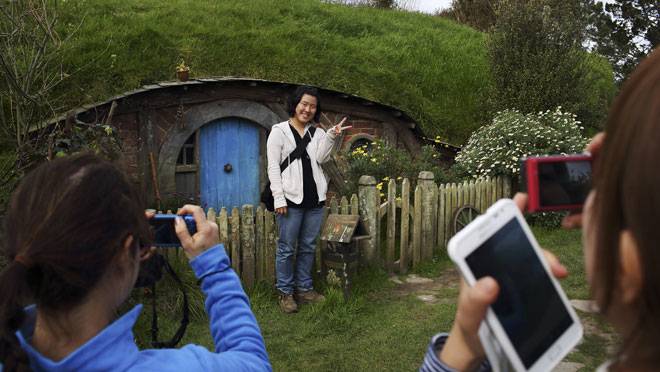
NEW_ZEALAND_HOBBIT_ADV07_1

But what of the deeper layer of a Hollywood blockbuster — if one at all? A.O. Scott, a writer for NY Times entertains the concept of political perspectives in Avatar. It questions and allows audiences to critique character motives and actions, in way of representing current day society. A quote I think is fitting for this notion: “… Like most good popular movies, ‘Avatar’ is accessible enough to invite such debate and complicated enough to keep it unresolved and interesting”.

How does LOTR: ROTK as a Hollywood blockbuster involve politics? Abigail E. Ruane and Patrick James for International Studies Perspective expand on this idea — by praising LOTR’s writing and character development. Thanks to J.R.R. Tolkien and Peter Jackson, they have created a world with various cultures and social hierarchies. Each character has a different worldview and political stance driven by their race, place in social and economic hierarchy, gender, and sexuality, which can allow audiences to better understand international relations. LOTR has a strong depiction of rationalisation against neorealism. The rational decisions in ROTK lie with Gandalf, while neorealism is presented through Denethor — the steward in charge of Gondor. The vast difference between the two — and the political approach they represent — is summarised in their meeting scene in the halls, where Gandalf plans proactively, and Denethor insists on war. This is a play on power politics and how it is aligned with war rather than peace.

rotk0537

Beyond its box office attraction, marketing and political ambivalence, I feel this is a superb film. An analogy I am drawn to regarding a ‘good’ film — there are lots of different ingredients, and all need to be applied the correct amount. LOTR: ROTK has a range like no other — incredible cinematography with chilling soundtracks, heart-to-heart conversations, epic battles, and combining all, elite storytelling. I am a sucker for storytelling.

Peter Jackson has an incredible technique. When Denethor demands Pippen to sing a song moments after he sent his son to ride to seemed-to-be death… Goosebumps. The cuts between father eating an exotic meal, contrasting with son (and army) facing slaughter — and the final note of the A Capella rendition, tomato dripping down Denethor’s face as a visual metaphor. The perfect mix of all the elements.


To me, the journey the audience takes with the characters is as impactful as the film itself. The distance the viewer travels with Frodo and Sam from The Shire to Mt Doom. From meeting a character like ‘Strider’ sitting in the darkness of a bar (in LOTR: The Fellowship of the Ring) to ‘Aragorn’ leading a charge into Mordor is the epitome of satisfaction and completion in a long winding story.


For a Hollywood blockbuster, LOTR: ROTK is so unique as it follows the “rules”, but then redefines them in others. I love the sense of fulfilment, ending on a climax, and the mixed emotions that come with it. To summarise areas where LOTR differs, when Elijah Wood was asked what was it like to work on LOTR, he responded with like an indie film with a 94 million dollar budget. LOTR: ROTK is better than second breakfast… AKA 5 stars.

IF any reader wishes to do some further reading on LOTR, here is a link to a fascinating journal article discussing its depiction of friendship, masculinity and femininity. 

References

Box Office Mojo 2017, ‘The Lord of the Rings: Return of the King’. Available from: < http://www.boxofficemojo.com/movies/?page=main&id=returnoftheking.htm>.

Li, S, Li, H, Song, H, Lundberg, C, & Shen, S. 2017, ‘The economic impact of on-screen tourism: The case of The Lord of the Rings and The Hobbit’, Tourism Management, vol. 1, no.1, pp. 177-187. Available from: < http://eds.a.ebscohost.com.ezproxy.uow.edu.au/eds/detail/detail?vid=4&sid=b74ee001-548e-40de-80c4-7b5485130632%40sessionmgr4009&bdata=JnNpdGU9ZWRzLWxpdmU%3d#AN=S0261517716302400&db=edselp>.

Pinchefsky, C. 2012, ‘The Impact (Economic and Otherwise) of Lord of the Rings/The Hobbit on New Zealand’, Forbes. Available from: <https://www.forbes.com/sites/carolpinchefsky/2012/12/14/the-impact-economic-and-otherwise-of-lord-of-the-ringsthe-hobbit-on-new-zealand/#269309ba31b6>.

Ruane, A.E, & James, P. 2008, ‘The International Relations of Middle-Earth: Learning from The Lord of The Rings’, International Studies Perspectives, vol. 9, no. 4, pp. 377-394. Available from: < http://eds.a.ebscohost.com.ezproxy.uow.edu.au/eds/pdfviewer/pdfviewer?vid=2&sid=8ce19024-9b77-4cad-8304-f2d3c02e4d00@sessionmgr102>.

Scott, A.O. 2010, ‘Turncoats Who Become Heroes’, The New York Times. Available from: < http://www.nytimes.com/2010/02/07/movies/awardsseason/07scott.html?mcubz=3>.

Stringer J. 2003, (ed.) Movie Blockbusters, New York: Routledge.

Sports Fans & Social Media

Sports Fans & Social Media


I had the enjoyment of creating a video about two personal interests – sports and digital media. The project discusses the positives and negatives to social media intertwining with fan culture. As my last BCM assessment, I thought the topic was suitable. Below is the video:


Comment below your thoughts on the topic – I would love to hear some perspectives.


References

Ko, M, Yeo, J, Lee, J, Lee, U, & Jang Y J. 2016, ‘What Makes Sport Fans Interactive? Identifying Factors Affecting Chat Interactions in Online Sports Viewing.’, PLoS ONE, vol. 11, no. 2, pp. 1-20. Available at: <http://eds.b.ebscohost.com/eds/detail/detail?sid=999d9f80-dbfe-4f3a-95ed-6ae1889fbfb6%40sessionmgr101&vid=0&hid=111&bdata=JnNpdGU9ZWRzLWxpdmU%3d#AN=112804807&db=a9h>.

Last, J. 2017, ‘Beware of Echo Chambers’, Mediapost. Available at: <https://www.mediapost.com/publications/article/292567/beware-of-echo-chambers.html.>.

Mudrick, M, Miller, M, & Atkin, D. 2016, ‘The Influence of Social Media on Fan Reactionary Behaviours’, Telematics and Informatics, vol. 33, no. 4, pp. 896-903. Available at: <http://eds.b.ebscohost.com/eds/detail/detail?sid=b295a5fe-b144-40e4-b502-bbd40617c968%40sessionmgr103&vid=0&hid=111&bdata=JnNpdGU9ZWRzLWxpdmU%3d#AN=S0736585315300691&db=edselp>.

Price, J, Farrington, N, & Hall, L. 2013, ‘Changing the Game? The Impact of Twitter on Relationships Between Football Clubs, Supporters and the Sports Media.’, Soccer and Society, vol. 14, no. 4, pp. 446-461. Available at: <http://eds.a.ebscohost.com/eds/detail/detail?vid=1&sid=08eacf0a-f699-4994-afd7-3f098a00ed2a%40sessionmgr4006&hid=4110&bdata=JnNpdGU9ZWRzLWxpdmU%3d#AN=89432180&db=a9h>.

Vinfotech 2017, ‘Will social media be the new stadium for sports fans in 2017?’. Available at: <http://www.vinfotech.com/blog/why-social-media-is-the-new-stadium-for-sports-fans>.

Image References

#WengerOut at Coldplay Bangkok 2017, Twitter, Thailand, viewed 28 May 2017. Available at: < https://twitter.com/jaik_singh/status/850957942023012352>.

#WengerOut made it to the #DiploinKenya Concert 2017, Twitter, Kenya, viewed 28 May 2017. Available at: < https://twitter.com/DjRigz/status/853547149795229696>/

Byrne, D. 2017, ‘The Echo Chamber’, DavidByrne, Unknown, viewed 28 May 2017. Available at: < http://davidbyrne.com/journal/the-echo-chamber>.

Wenger Out Time for Change 2017, Twitter, Unknown, viewed 28 May 2017. Available at: <https://twitter.com/NoNewContract/status/853297553726726148>.

Creative Commons References

Burns, C. 2017, Sydney, March 27 via Unsplash, Public Domain CCO.

Clarkson, P. 2016, Futsal Pitch, September 23 via Unsplash, Public Domain CCO.

Dau, E. 2016, Fans, September 22 via Unsplash, Public Domain CCO.

Delanoix, A. 2015, New York, February 11 via Unsplash, Public Domain CCO.

Dibert, D. 2016, London, April 29 via Unsplash, Public Domain CCO.

Iven, W. 2015, Facebook Social Media, May 29 via Unsplash, Public Domain CCO.

Leggat, C. 2015, Typewriter Communication, October 29 via Unsplash, Public Domain CCO.

Keenan, A. 2015, Wide Angle Football Pitch, May 11 via Unsplash, Public Domain CCO.

Martinez, H. 2016, Communication Mediums, July 14 via Unsplash, Public Domain CCO.

Rosen, M. 2016, Stadium, September 16 via Unsplash Public Domain CCO.

Sapegin, A. 2016, Macbook, December 26 via Unsplash Public Domain CCO.

Vivek, H. 2017, Instagram Social Media, February 27 via Unsplash, Public Domain CCO.

Virus, B. 2017, Barcelona, January 22 via Unsplash, Public Domain CCO.

Big Cats – and We’re not Talking the Musical

Big Cats – and We’re not Talking the Musical

Just yesterday, I received a promotional e-mail for partaking on a journey to the Himalayas to photograph Snow Leopards. Humans and animals share a unique bond that is seen in few things. Specifically, big cats such as Tigers, Lions, and Leopards. We anthropomorphise exotic animals in media – by definition: giving a non-human organism human traits. We have an unusual relationship with them where we apply human attributes to a tiger or lion, but we do not always picture them on equal levels. In a surprisingly non-human manner, we often place tigers, lions or leopards on a higher pedestal than ourselves. We idolise them. We hold them above us and sing the Circle of Life.


Credit to: Walt Disney.

Some cultures in the world revolve around these animals. In Asia, the tiger is symbolic. It is feared for its characteristics but loved for the exact same. The tiger is encountered from Asian mythology to martial arts. In fact, Cantonese martial art  – Hung Gar – create combat based off tiger depictions of strength and speed (Lam et al 2012).

The lion encompasses African culture due to traditional art, music and contemporary films like the aforementioned Lion King. Lions depiction in culture spreads further than that continent alone. The perceived fierce beast is entrenched in Macedonian lore – symbolic for conquering kings and battlefield remains. Ancient history reveals 338 B.C., the Macedonians built a proud lion statue after a victory against the Greek. It continued to represent the nation.

In modern day, big cats are seen dominating National Geographic’s wildlife art and documentaries alike. Now the question is: does anthropomorphising tigers, lions and leopards benefit the animal in regards to conservation?


Credit to: National Geographic

Documentaries like Big Cat Diary and Tiger: Spy of the Jungle utilise human traits in jungle-cats. The titles anthropomorphise the animals with words like ‘Diary’ and ‘Spy’ as these are human nouns for human usage. Big Cat Diary focusses on specific lions, giving them names, identities, and personalities that the presenters and audiences can form emotional connections. Tiger: Spy of the Jungle used new technology to capture innovative shots of the life of a tiger and reveal more about their habits and lifestyles.

Perhaps both documentaries are over-dramatised but as an argument was raised in class by fellow colleagues, humans love stories. By applying human attributes, it draws more viewers. Anthropomorphism can help us learn about ourselves and the animal shown.

Sadly, in the ten year span of 2003-2013, 10 000 lions were hunted for exotic trophies and exported from Africa overseas (Blood Lions 2015). Conservation units (at time of article posted) revealed less than 20 000 wild lions roamed. I was rocked by this statistic. Documentaries like Big Cat Diary and Tiger: Spy of the Jungle can aid in conservation with a domino effect: anthropomorphising, which is said to encourage conservation actions by “knowing the target audience and tailoring the message” (Tam 2015), thus creating awareness for the animals and their dangers.


If the audience desires effectance or social connection strongly, anthropomorphic appeals could be useful. – Kim-Pong Tam


Anthropomorphism may not be a definite solution (N.D.). The method can potentially hurt the animal. The idea of neglecting the animals’ needs for our own is a real possibility. The human story may occasionally override the animal’s story. As an example, the connection in Big Cat Diary between lions and presenters/audiences could overshadow the underlying fact – these animals have become scarce. As for Tiger: Spy of the Jungle, the focus on new camera shots and technology could detract from the overall story, too. I wish to reiterate I am not saying this is the case, but just a possibility from anthropomorphising non-human beings. Dr Nicola Evans (2017) suggested a similar con in March of the Penguins where the documentary failed to address climate change in the antarctic.


Animals with human traits depictions have existed long before us, and will continue to happen in the future. Various media channels have roles to play – documentaries, photography and endorsements on social media to create awareness and action. I’m not sure if anthropomorphism is the right way, but if it does more good than harm for conserving the species we share the world, then it is the best we have.


If you have a more detailed thought, please comment below.


References

Bloodlions.org, 2015, Analysis: Hunters Bagged 10 000 Lions since 2003, Available at: http://www.bloodlions.org/analysis-hunters-bagged-10000-lions-in-africa-since-2003/ [26 March]

Evans, N, 2017, The Animal. 

HistoryofMacedonia.org, 2013, The Macedonian Lion, Available at: http://www.historyofmacedonia.org/Macedoniansymbols/MacedonianLion.html [26 March]

Lam, W, & Alamudeen, S, 2012, ‘The Dynamic Impact of The Tiger within Chinese Martial Arts’, Revista de Artes Marciales Asiáticas (Magazine of the Asian Martial Arts), vol. 3, no. 3, PP. 58-67. Available at: http://eds.b.ebscohost.com/eds/detail/detail?vid=8&sid=84d0d956-1e4d-46b8-a738-f72ccfb931c3%40sessionmgr104&hid=113&bdata=JnNpdGU9ZWRzLWxpdmU%3d#AN=edsdoj.3b6a06006edb4661824d7357520bdf84&db=edsdoj [26 March]

Nationalgeographic.com, N.D., Wildlife Photo Gallery, Available at: http://www.nationalgeographic.com/photography/photos/wildlife-photo-gallery/ [26 March]

Rheg.vastserve.com, N.D., Anthropomorphism of Animals, Available at: http://rheg.vastserve.com/articles/animals-anthropomorphism.htm?i=1 [26 March]

Tam, K, 2015, ‘Are anthropomorphic persuasive appeals effective? The role of the recipient’s motivation’, British Journal of Social Psychology, vol. 54, no. 1, PP. 187-200. Available at: http://eds.b.ebscohost.com.ezproxy.uow.edu.au/eds/detail/detail?vid=15&sid=5a9aea3e-8305-44fd-aaa9-2295abda4bf1%40sessionmgr102&hid=120&bdata=JnNpdGU9ZWRzLWxpdmU%3d#db=pbh&AN=101470787 [26 March]


Poverty in Media: Provoking Actions or JUST Entertainment?

Poverty in Media: Provoking Actions or JUST Entertainment?

Warning: photos may cause distress.

Sensitive topics displayed through the media is a dangerous game. It may benefit a cause – or worse yet, it could raise concerns amongst the audience questioning the humane nature of the creators. Visual content transcended the media landscape with the rise of photojournalism and television overthrowing or at times co-existing with literature (Simonsen et al 2013). Visual communication based off society has become prominent in recent years with poverty porn.

Poverty porn as described by Nathalie Dortonne, CNN, is the exploitation of suffering in any culture. 

I agree with some points in this piece – and disagree with others. It is fair to argue that poverty porn does not represent a true community – for example, the media frequently portrays a poverty-induced Africa, but not all Africa is in poverty. However, I do not believe because that is the case means we disregard an attempt to help solve a tragic issue; because some parts of Africa ARE poverty-induced. There is a need for middle ground and I believe visual content can aid in the greater good.

Graphic photos or poverty porn began to gain momentum during the Second World War. Photographers were tasked with taking gritty and violent pictures to show the harsh conditions of war. Photojournalists would carry the wounds from their profession, and some worse. Robert Capa – who became famous for his craft – died while on a mission.

Beyond war, photographers were used in resettlement of farmers during the drought and Depression in mid-America in the 1930s.

Post-1970s, video was an alternative to photography due to the impact of being ‘live’ at the land. Today, the two blend when covering poverty (Collins N.D.).

Credit to: https://www.ndsu.edu/pubweb/~rcollins/242photojournalism/greatphotos/index.htm

The argument is between art/entertainment, or is it done to help the a dire situation. This debate was ongoing through a rather famous photo of an African child in starvation, with a chilling vulture looming in the background. Artist: Kevin Carter. *Warning: distressing photo.*

Credit to: http://100photos.time.com/photos/kevin-carter-starving-child-vulture

The background of the photo: Kevin Carter flew to Sudan in 1993 as a member of the Bang-Bang Club – a group of photojournalists operating in southern Africa from 1990-1994 to enlighten audiences on the suffering in some parts of the continent, and hope for aid. Carter left a nearby village after a day of shooting. He encountered a toddler in agony on path to a feeding centre. He took the photo with the vulture in the background. The New York Times posted the photo. Controversy followed with audiences split between exploitation – and opposing that, it was needed for action and awareness. Carter took his own life months after the photo was captured writing he was haunted by “memories of killings and corpses and anger and pain”.

The repercussions of the debate regarding poverty porn is deep. It raises this question: was it worth doing? In order to try and answer this, I will compare this photo with two pieces of video content – Struggle Street by SBS Australia, and Jack Black Meets Homeless Boy by Comic Relief. Alexis Sobel Fitts and Nicola Pring from Colombia Journalism Review (2014) write “reporting that takes readers inside the lives of the poor is arguably journalism’s most powerful tool”. A powerful quote. Perhaps, this is what made Struggle Street hard to empathise with, as its first priority is entertainment rather than provoking action. The characters in the show conflicted with the producers as it often seemed the narrator was making the series a comedy. Struggle Street was labelled poverty porn in Australia – by inaccurately representing Mt Druitt – and rightfully so as it makes little attempt to help the community.

“Reporting that takes readers inside the lives of the poor is arguably journalism’s most powerful tool”

As for Jack Black Meets Homeless Boy, it shares similar characteristics with the starving child photo. The story revolves around one child’s story, it displays the harsh nature, it caused similar debate and questions the morality of creators by not helping the children. Both respond in the same manner; the story represents many persons’ lives and through Comic Relief and Bang-Bang Club, they want to better the world. I can see and understand where the argument originates of exploiting the children, but if Comic Relief raised just one more dollar to improve their lives – it is one more dollar they can do good with.

Thus, if the content provokes action, then for me, it is worth showing.

A question for the readers: what are your thoughts on poverty porn in the media? Should it be shown? Does it isolate poverty issues in our own culture? Or is it simply inaccurate? Comment below.

Thanks for reading!

References

Collins, R, N.D., A Brief History of Photography and Photojournalism (online), North Dakota State University, Available at: https://www.ndsu.edu/pubweb/~rcollins/242photojournalism/historyofphotography.html [19 March].

Dortonne, N, 2016, The Danger of Poverty Porn (online), CNN, Available at: http://edition.cnn.com/2016/12/08/health/poverty-porn-danger-feat/ [19 March].

Fitts, A S & Pring, N, 2014, Are we Journalists First?, Colombian Journalism Review, PP. 37-40. Available at: http://eds.b.ebscohost.com.ezproxy.uow.edu.au/eds/pdfviewer/pdfviewer?sid=f4c75082-b5fe-4ab9-906c-01d0d7676eab@sessionmgr4008&vid=4&hid=4110. [19 March]

Simonsen, P, Peck, J, Craig, R T, & Jackson, J, 2013, The Handbook of Communication History, First Edition, [Ebook], New York: Routledge, PP. 257. Available at: https://books.google.com.au/books?id=NE6HHMDzvLkC&printsec=frontcover#v=onepage&q&f=false. [19 March].

Time 100 Photos, N.D., Starving Child and Vulture, Available at: http://100photos.time.com/photos/kevin-carter-starving-child-vulture. [19 March].

Branded Self & The Human Condition

Branded Self & The Human Condition

Three years into a Bachelor of Communications and Media degree; majoring in marketing – only last Wednesday, I realised we are natural marketers. We sell an image of ourselves via social media channels; the branded self. The image consists of carefully selected photos displaying qualities we admire about ourselves – “one owns oneself as though one is a business, a collection of skills, assets and alliances that must be continually maintained” (Gershon 2014). Facebook, YouTube, Instagram and Twitter can be argued as the catalyst for the mediated culture seen today. The platforms place emphasis on the need to have a ‘profile picture’ which overtime has instigated the act of ‘selfies’. The key to our online personas for future employment. ‘Selfies’ are much more convoluted than the act or name. I pose the question: by posting ‘selfies’ that may not be an entirely true representation, does it have repercussions on ourselves, and the audience looking on?


“one owns oneself as though one is a business, a collection of skills, assets and alliances that must be continually maintained”


Long before the term ‘selfie’ was coined or Snapchat was working on their selfie filters, photos of ourselves have been components in history. Severn (2016) analyses the selfie like a family tree. The branches extend for centuries. You can identify similar characteristics from the actions hundreds of years ago to today. The first stage of a ‘selfie’ were mirrors – before the mirror was created, some people could go their entire lives without knowing how their face looks. The self-portrait was next. Artists in the 14th and 15th century would often depict themselves in “historical, biblical or mythical scenes”. German painter Albrecht Dürer had a vast range of ‘selfies’ such as drawings in fancy dresses, himself as Jesus, and beating Kim K to nude selfies. Self-portraits have been instilled in culture.

Pewdiepie posted a video in January 2017, explaining his thoughts on a Harvard Business Review article about ‘happiness’ in the online world. They apply a theory that people force positivity or fake happiness in attempt to attract viewers – “I think a lot of people on YouTube are drawn to positivity”. This can be adapted to the idea of branded ‘selfies’ on social media. The branded self encompasses a positive and professional outlook due to employers research on social media, during the interview stage. By maintaining “forced positivity”, it could cause danger to the audience and oneself. The professional persona is not a true representation of a human being. Humans have different emotions at any given time – the human condition. It is impossible to always be happy. Hannah Schacter (2015) discusses the psychological effects social media can have on an audience. An example may be the “forced positivity” or professional profile on a social gathering, and may trigger “a sense of exclusion, envy or loneliness” for the viewer. It may tap into the human condition and entertain thoughts of uniqueness due to various emotions rather than the one solely shown, happiness.


Of course, the situation is dynamic and this does not mean a branded self leads to unhappiness. There are positives to ‘selfies’ and I will delve into that now.


Selfies fight back. It may sound like a Hollywood blockbuster movie but in a sense it is true. Users are beginning to post with more freedom. With this might come a more accurate depiction of ourselves. Celebrities have taken this approach. ‘Ellen’s Oscar Selfie’ encouraged a few celebrities to goof around. The internet exploded at the sight of celebrities partaking in the new phenomenon. In addition to the response, it raised $3 million for charity. Nicola Evans (2017) enlightened her class of the other side of a ‘selfie’ – a ‘breast feeding selfie’. The photo was intended to place emphasis on the realism of breast feeding. The picture was followed by a rather descriptive and colourful caption, but in its essence, was about showing all selfs online – as aforementioned, humans have different emotions and different selfs depending on social groups. Last night, my sister saw an Adele concert, and posted a selfie. The first thing that came to mind was not narcissism, nor was it a professional persona. It was something in between – and hopefully over time this is the “professional persona” businesses analyse for employment.

Credit to Ellen DeGeneres. https://twitter.com/theellenshow/status/440322224407314432


‘Selfies’ are a multi layered concept that is not black or white. Branded selfs float between the two. Perhaps, audiences and business alike have to understand there is much more to a person than a ‘selfie’ but that does not mean to eradicate any professionalism online.


I would like to ask a question to readers. Do you naturally, or purposely maintain a branded self across social media?


References

Evans, N, 2017, The Self.

Gershon, I, 2014, Selling Yourself in the United States, PoLAR, Vol. 37, No. 2, PP. 281-288. [12 March]

Schacter, H, 2015, Me, Myselfie and I: The Psychological Impact of Social Media Activity, Psychology in Action, Available at: http://www.psychologyinaction.org/2015/09/07/me-myselfie-and-i-the-psychological-impact-of-social-media-activity/ [12 March]

Severn, C, 2016, Before the Selfie: A Brief History of Looking at Ourselves, KQED Arts, Available at: https://ww2.kqed.org/pop/2016/06/09/before-the-selfie-a-brief-history-of-looking-at-ourselves/ [12 March]

The Regulators: The Final Reflection

The Regulators: The Final Reflection

The final BCM240 project consisted of four videos uploaded to YouTube as a catalyst to stimulate discussion on certain topics from the BCM240 course. As noted in my research proposal, I collaborated with Lauren Mulhall and Tom McGill — students partaking the same course. There was eight weeks worth of content to choose from, and we chose four — meaning we held discussions over our preferred topics. We all share common interests in film and television which was impactful in the themes selected. We spoke about cinema experience, debate on action movies making people fat, TV memories, and attention span. With each of these, we tied in theorists from BCM course such as Hagerstrand (2001) and Amanda Bruce (2007), but our secondary research with Gosling and JAMA Medicine (2014). Our goal was to blend academic discussion while having fun in a relaxed environment, hopefully making the content easier to consume for audiences.

Our content was uploaded to a YouTube channel named ‘The Group Channel’. Perhaps this is reflexive in why we chose this platform too. Lauren, Tom and I all worked together on this channel previously as we all have interest in creating entertaining content to share while having fun. During our previous project (not an academic project), we built a foundation of viewers with subscribers and reoccurring watchers. The audience was already established, and in addition, share similar interests so more likely will watch ‘The Regulators’. The three of us are BCM students, therefore we continuously analyse the strengths and weaknesses to mediums available to us. There are multiple platforms for video digital storytelling such as YouTube, Vimeo, or even uploading directly to Facebook as that is a growing channel. Information technology opens up a gate for learning in innovative ways, and is encouraged to be used in classrooms more and more. It has the ability to present information on educational issues and trigger critical thinking (Alwehaibi 2015). This encompasses our goal set from the beginning — consuming educational content in a relaxed manner. YouTube was selected for the reasons listed above, and the sheer size of a video distribution network.

We made alterations in our project after the first recorded episode. It has been mentioned in previous classes like BCM210 by Kate Bowles, and currently in BCM240 by Susan Maloney and Stephanie Hanson(2016) that research is often about failing, and trying again — for example, trial and error on your methods. Our first unpublished video was vague and had no real direction in terms of discussion or theorists. We attempted to cram as much information as possible which hurt the overall product. From failing, and trying again, our four published videos have individual related theorists with a much more guided debate.

There are many aspects I will take from this experience — ranging from collaboration, to creative editing, to project management. This assessment was not group compulsory and more often than not, students will tend to avoid group work whenever possible. However, the three of us share a strong relationship and were adamant working together was best to create a higher quality digital narrative. Time/project management is integral due to the impact it can have overall — if done inadequately, it can harm the piece. There are methods to management such as task responsibilities and priorities, create a schedule and estimate time (Tran 2015). The management was split amongst us for video editing and uploading to ensure shared responsibilities. The first three episodes were filmed, edited and uploaded to the predicted rate, however, admittedly, episode four has not been uploaded with the schedule. This is an issue I have to work on in the future.

Due to the digital narrative uploaded online, it opens up the availability to return whenever needed. Especially in the future. It is highly likely as a media student, I will have a similar assessment in the future using digital platforms (and I hope so as an enthusiast for these assessments), I can revisit these videos to discover what was successful, what was not, and why they did or did not work. It is possible to use it as future references. As for others, if the project is received well, hopefully students in the coming years can look up and research our project.

Overall, this assessment was an enjoyable experience. It was fun-filled by working with not just colleagues but friends, while also challenging to find suitable theories. The stories told were insightful and educational. However, there are aspects to be revised as nothing is perfect. Thank you BCM240 for having an interesting subject with creative freedom for the final assessment.

Videos

Episode 1

Episode 2 

Episode 3 

Episode 4

References (in text, theories are located in description of videos)

Alwehaibi, O 2015, ‘The Impact of Using YouTube in EFL Classroom on Enhancing EFL Students’ Content Learning’, Journal of College and Teaching, vol. 12, no. 2, pp. 121-126.

Tran, L 2015, ‘The Importance of Time Management (Aspects of Project Management Part 1)’, In Loox Blog, weblog post, 10 April, viewed on 26 October 2016.

Take Time to Review & Reflect

Take Time to Review & Reflect

There have been many blogs since the inaugural post in BCM110 2015. Many classes have encouraged blogging, while some have required an online presence. I have always enjoyed writing, but I never envisioned that it would be such an integral part of my course. Now that it has, each blog brings a feeling of enjoyment, and I challenge myself to do better with the next one. Blogging is preferred to essay or report writing because of the blend of scholarly writing with a toned down approach. It feels as if students are allowed to write with more freedom and engage in topics in a creative manner. My goal in blogging is to create a consistent (preferably large) viewership and interact with readers, as I feel that adds to an overall experience of a blog. There were positives in the task 1 feedback, but also points that I need to work on. This is an indication I have a way to go before reaching my goal.


Feedback:


“Solid engagement with lecture ideas, good evidence of secondary research and connection to other students. Your writing style tends to be too colloquial for academic work so work on word usage and sentence structure. Also watch grammar. Provide source for images.”


I was ecstatic to see I understood the content well enough to write an adequate blog on the topic, especially within the first four weeks. Collaborative Ethnography was where I was uncertain on how to write about, however since a third party has recognised there is a “solid engagement”, I approach each blog with more confidence. Susan Maloney (2016) and Stephanie Hanson in tutorials reiterate how crucial secondary research is through hyperlinks or references. It adds an aura to the piece suggesting the writer is knowledgeable and reliable with the respective topic. In all posts for BCM240, I have set a goal to integrate at least 3-4 hyperlinks or references that support the claims made, or expansive information on the paragraph being discussed. I used hyperlinks very little before this semester, but will continue to utilise them after BCM240 culminates.

Too colloquial is the most worrying part of the writing feedback. I was concerned I was writing with too much simplicity before BCM240, so I attempted to fix the issue beforehand. Sadly, I was unable to achieve that. I aim to amend this mistake because scholarly writing involves a ‘productive writing process’, which I feel I have changed since the task 1 feedback. Rachael Cayley (2016) recognises there is a difference between writing productivity and a productive writing process. Writers need consistency – which there is a lack of in regards of productivity, however there can be consistency in writing processes. In addition, I have also eliminated the ‘wordiness’ in the first lot of blogs. Blogs entail easy reading while engaging. There is a need for clear communication and concise words to ensure a smooth read (APA 2015). For example, in ‘Constraints of Star Wars’ and ‘Please Don’t Regulate my Games’, it was wise to cut words that ended in “l-y” like “interestingly” and “shockingly” as they were not needed and disrupted the flow.


Feedback:


“Some effort at adding value through images, links, tags and categories however I found the site difficult to navigate ‘home’. Also could not find your ‘about me’ page or Twitter handle.”


Design is critical in a variety of ways. It is the initial viewing of the website – first impressions matter. Waters et al (2014) analyse the importance of design on successful corporate blogs. The top 500 blogs share common aspects. All designs are simple, represent the company or user effectively, easy to navigate and searchable. The simplicity of design directs audiences into two-way communication – always a blogging goal. Due to the feedback, the design was reconstructed to a more traditional layout. The blogs now appear in chronological order on a white background with black font. Above is the header displaying the webpage’s name. This is where the reader will find the menu. There are two ways to access it but the most efficient is the menu button in the right hand corner. The About Page and Categories will appear downwards. In regards to Twitter and Instagram, they are displayed in clear sight now, after being moved to the left hand side of the homepage and every post. As for visuals within blogs such as images and videos, I utilise videos that match the content, for example, in the Proposal, I linked a YouTube video related to the section on online film reviewing. However, I need to use more images that add to the overall experience.


It has been reiterated throughout the course that blogs need readership Blogging is a saturated market – making it difficult to effectively spread work. Twitter is our biggest ally as bloggers; Joel Cascoigne, a blogger, tweets to understand his audience (Cooper 2013). I tweet after every post using the hash-tags ‘BCM240’ and find relevant connections to make other hash-tags. For example, using ‘#attentionspans’ for the affiliated blog post. Through Twitter and metadata tags on the wordpress, we are able to see other bloggers within the course and read and comment on their work. Comments can be the first step in a formidable relationship with other writers. I have tried to encourage comments on my blogs by posing questions to readers – it has been successful on ‘Please Don’t Regulate my Games’ gaining an insight on the viewer about their experience with regulated games.

My blog has reached audiences outside of university as well. I was contacted by My Trending Stories to work with them. This opens up a channel to a much larger audience – with approval to promote personal blogs on their site.


Overall, I have learnt more from blogging this year than all the years in my life combined. The craft has not been mastered, but it is a journey to get better and earn a reputation. The topics discussed in BCM240 have been the most enjoyable and I look forward to continue writing.


References

Cayley, R 2016, ‘A Productive Process’, Explorations of Styles A Blog about Academic Writing. Available from: https://explorationsofstyle.com/. Accessed on 2 October.


Cooper, B 2013, ’16 Top Tips from Blogging Experts for Beginners’, Buffer Social. Available from: https://blog.bufferapp.com/blogging-advice-for-beginners-from-16-experts. Accessed on 2 October.


Lee, C 2015, ‘Principles of Writing: How to Avoid Wordiness’, APA Style. Available from: http://blog.apastyle.org/apastyle/2015/09/principles-of-writing-how-to-avoid-wordiness.html. Accessed on 2 October.


Maloney, S 2016, ‘Lecture 1’, UOW Subject Code BCM240, Lecture, UOW, Wollongong.


Waters, R, Ghosh, P, Griggs, T, & Searson, E 2014, ‘The Corporate Side of the Blogosphere: Examining the Variations of Design and Engagement Among Fortune 500 Blogs’, Journal of Promotion Management, vol. 20, no. 5, pp. 537-552. Available from: http://eds.b.ebscohost.com/eds/detail/detail?sid=f3851178-9707-4c8a-9804-3857041adff8%40sessionmgr106&vid=0&hid=103&bdata=JnNpdGU9ZWRzLWxpdmU%3d#AN=99282959&db=ufh. Accessed on 2 October.

Have I Got Your Attention Now?

Have I Got Your Attention Now?

My first phone was a Nokia brick – the standard amongst most young adults. The phone offered very little that made it a worthy distraction… Besides Snakes (the game). Compare that Nokia to today’s iPhones or Samsungs, the Nokia is a few steps behind. Smart phones have opened up the world in the palm of our hand that can also slide into our pocket. Most of us who own smart phones will go through the infamous routine of opening up an app, looking through the app for a few moments, close the app, open a new one, close the app, open up a social media, close the social media. The cycle can vary on length. It shares similarities to the Wikipedia Rabbit Hole, where there is a constant absorption of information. I expect you, the reader, will be jumping in between multiple channels while reading – and there seems to be a negative connotation to digital screens, the idea they are decreasing attention spans. I intend to contrast this conception with a rebuttal that as time goes on, we learn to process more in a smaller frame.

Everybody has a unique length of attention span. It is something individual. Attention spans have been recognised and discussed long before the digital age. Essentially, the digital tools were substituted for other options in different scenarios. Even the argument suggesting there are benefits to multitasking was established at least 90 years ago. Virginia Heffernan’s NY Times essay on attention spans critically thought about Bertolt Brecht’s ‘Smokers’ Theatre’. The concept encouraged German theatre-goers in the 1920s to light up cigars in the middle of performances, along with pacing and talking to test the strength of performers’ multitasking. In the 21st century, theatre companies may aim to be more interactive with their audience as plays that adapt rather than block out the digital input can be more successful. The usage of hash-tags on television and theatre shows is a fine example of encouraging digital usage. It is possible to replace cigars, pacing and talking with Facebook shares, Instagram and Tweeting.

“Ideally, an immunity to tyranny”

Our attention spans have decreased from 12 seconds (2000) to 8 seconds (2013) – and, lower than a goldfish. Yes, digital growth over that period may have impacted the measurement, however, it is wise to analyse the context in which we use our devices. Often, it is done to engage and connect with others.

Credit to: www.ethos3.com
Credit to: http://www.ethos3.com

This attention spans report exposed 79% of people use other devices while watching TV. This past week, I travelled to Melbourne with my cousin to visit another cousin. The two enjoy reality TV shows. I decided to try my attention experiment during a show to see how often they engaged with surrounding digital tools. The experiment aligned Australia Survivor – the show encourages usage of social media with displaying a trademark hash-tag. I aimed to grab their attention outside of the hash-tag. Throughout the show, I attempted to be as subtle as possible and send a range of different ‘distractions’ and looked for their responsive actions. They consisted of: a variety of Snapchat photos, Facebook notifications, and when they were on their devices during commercials, to pull their attention back to the TV by asking relevant questions. At the end, I asked how much information they gathered.

The results were reaffirming. Susan Maloney (2016) referred to young adults at excelling in switching between channels – her example was students using multiple web-browser tabs when researching or writing. The boys in my experiment were similar in some regards, by switching between mediums. The cross-information never got twisted, as the subjects were able to discuss the show in a relatively deep conversation, despite utilising other platforms such as Facebook and Snapchat in the same process.

It will be eye-catching to see the average of attention span in ten years. Already at eight seconds, it is a short timeframe, but needs to be thought of in context. As long as the information consumption process is not affected.

What are your thoughts on attention spans? Comment below. Thanks for reading!

Proposing a Podcast

Proposing a Podcast

I am excited for this assignment. When you get that feeling, it is a nice indication that you are doing the right degree. A digital storytelling assessment is one of the best ideas I’ve encountered at university. It entails an academic approach by engaging in content and concepts analysed over the course of nine weeks, but we – the students – have creative freedom in the regarding which media as a platform. The perfect mix.

Who will I work with? The best part about creative freedom is I have the choice. I will collaborate with Lauren Mulhall and Tom McGill – two students also partaking the class. We want this project to be the best possible, and it is noted working with others is beneficial in a successful large project. Each member will have a shared role in the digital storytelling.

The platform is a visual and audio podcast. Uploaded to YouTube and SoundCloud, respectively. The decision to have two versions was to cater for different audiences. Each has their benefits. Some wish to consume their content via strictly audio, being a little longer and the accessibility simpler than a video. However, ironically – a topic for our podcast, but I will get onto that later – the attention span is decreasing as years pass. Stephanie Hanson even raised the point that humans have a smaller attention span than goldfish. This was the catalyst behind our decision to make a visual podcast as well. The YouTube video will go shorter, by displaying the highlights and most humourous but yet educational parts of the episode. We are hoping the combination of shorter and an image will hold viewers.

Credit to: https://au.pinterest.com/pin/265853184225670484/

The structure of the podcast was touched on earlier. Each member has a specific role. It will be split into three parts and no longer than 30 minutes (audio) – one part will be allocated to each of us, and our responsibility is to bring a different media – a film, TV show or sporting event to each episode to discuss topics from lectures.

Cinema, TV and sporting events on screen all capture personal interests and to be able to digitally discuss is a huge opportunity. The idea is to analyse the way the three impacts the environment around them in public and private areas. The way it shapes not only the physical place, but also the space in which we occupy (first BCM240 blog on spatial nature). For example, how are TVs setup around households or when, and where we go to the cinema. Does the film change the feeling in the space? If your team is losing in a sporting event, does that make a hostile environment?

Moreover, there is availability to discuss the way new media interacts with the more-considered ‘traditional media’. This day and age places emphasis on the way social media changes how we receive content. The social media realm appeals endless, as it ranges from advertising, to discussions with others who have experienced – in particular with cinema, often movie reviews have taken online with YouTube being a major platform.

Ultimately, new media leads to the topic of attention spans, which I too am guilty of in utilising my space. In our podcast, it will be interesting to see how often we multitask during film or TV and how much information is processed. We will also be encourage to take part in ethnography ourselves by studying those around us and the way they engage in entertainment. Media regulation is a lecture topic that can be discussed too as it fits the umbrella of cinema, TV and sporting events.

Our strategic plan to audience retention and viewership is much like blogging. It is to interact with the audience. The channel we will operate from is titled ‘TheGroupChannel’ which already has a stable subscriber count. YouTube has already established comment sections pushing us into a solid foundation to engage. We will also use a Twitter account to get a larger reach by using hashtags with relevant topics.

The project is in early talks, but is looking positive already. We can’t wait to record our first podcast and distribute for students and others to watch or listen.

Please Don’t Regulate my Games

Please Don’t Regulate my Games

Media regulation – it’s a scary term. It is one persons doing, to hide a certain visual or audio from a younger group, due to fears of negative effects. The government tend to regulate media ranging from cinema (discussed in lecture), TV, ownership of media – analysed in BCM110 with who can own radio, TV stations and newspaper in regional areas. Along with the traditional media listed, as new media develops, so do the laws on controlling the online market. It is worth noting, not all regulation is cause of government. However, the focus of this blog will be Australian regulation incidents with video games. Interestingly, most media Australians consume has been revised by a committee called a Classification Board and a Classification Review Board. These are the group of people who deem ratings like ‘G’, ‘PG’, ‘M’, ‘MA’ and ‘R18+’ and in doing so, limit viewing for younger audiences. It is possible the ratings have triggered moral panic – the most famous being violent games lead to violent children – or the moral panic caused the Classification Review Board to make these judgements.

I mentioned in my first blog post of 2016 that I spent time in my childhood playing video games. Admittedly, the PlayStation 2 and the Xbox had turned into a PlayStation 3 and an Xbox 360, and currently an Xbox One. So perhaps consoles have been a part of my life for more than just childhood. Arguably, the biggest game title in the world; Grand Theft Auto (GTA) has had its share of controversy. The franchise has released nine games on console, with most recent having downloadable content to add-on. Most of those nine games came out well-before I was an adult. GTA 5 was the most recent but still, I was just under the age of 18. Therefore, I am not going to admit I had played any GTA until 2014… Because that would be illegal. As for the controversial acts, it is only a quick google of Grand Theft Auto and its Wikipedia page has a long list of problems. Common Sense Media who attempt to rate, educate and advocate for kids, families and schools even have a comprehensive review on GTA 5. The game has recorded an outstanding five-stars in… errr… violence, sex and language. As you can tell, the game is off to a solid review. The highest-selling video game of all time is only allocated a single star for educational purposes. This is indicative of how some viewed the game as three women launched a petition in moral panic to remove the game from Target for Christmas of 2013. The petition caused Target and K-mart to eradicate GTA from its sales. This example will be analysed in positives and negatives of regulation.

This video intends to show funny moments from GTA but does involve some violent acts. Just a warning.

There is a solid basis to the need for regulation that would be difficult for even the most anti-regulators – simply, there are some things children should not see. To quote Tom McGill in this week’s tutorial, the Classification Review Board should have certain entertainment ‘M15+’ that anyone under the age of 15 should not have access to. However, he exposed inconsistency in the board’s reviewing. His example was a movie rated ‘M’ simply because it had “war themes” because it was set in that time period but had no violence, sex or language to match that rating. It is certain that Grand Theft Auto has aspects that need to be reviewed – violence against women is perhaps one of many. It would also be difficult to argue against its 18+ rating due to these. The Classification Review Board had done what is required of them.

However, it is the repercussions of these ratings that is worrying, and lead to Target’s regulation. The moral panic has quite simply misrepresented a large gaming culture, and game itself. The petition radically claims “games like this are grooming yet another generation of boys to tolerate violence against women”. The argument would be different had the sole purpose of the game to encourage violence on women, but this is inaccurate. I believe that users of the game will not accept violence against women, and especially would not change behaviour because it is on a screen.

This is a sensitive topic and it would be fascinating to have the capabilities to hold a grand-scale research project on GTA users and correlation to acceptance of violence against women. An early hypothesis? A high percentage will not tolerate.

Comment below if you think the eradication of Grand Theft Auto sales in Target was the correct or wrong decision. Let’s start a discussion.

Thanks for reading!